


In Situ Gamma Spectroscopy Systems for Soil and Surface Activity Measurements


View full version of this Application Note (PDF)

Introduction

Portable gamma spectroscopy systems provide a practical way to characterize dispersed radionuclides in or on the soil at nuclear facility decommissioning and restoration sites and surrounding areas. The objective is to determine radioactivity of plant-related nuclides per unit area or unit volume of soil. Traditional methods generally involve gross (non-spectroscopic) field surveys, followed by extensive field sample taking for subsequent laboratory gamma spectroscopic analysis. However, field surveys with gross counting instrumentation do not identify specific nuclides, and therefore cannot discriminate between plant-caused activity and anomalous distributions of natural or global fallout activity. Gross counting techniques also cannot detect small amounts of problem nuclides in the presence of larger amounts of other natural nuclides. Any discrete sample taken for laboratory analysis will only identify what was at that specific, very small, sample site. This means that for cases where the contamination is not uniform, some hot spot areas could be missed. In situ gamma spectroscopy, on the other hand, effectively detects all the radioactivity over as much as 100 m2 of area, and for high energy gammas, even detects radioactivity buried below the surface of the soil. With in situ gamma spectroscopy, there is a much higher probability that nothing will be missed.

With laboratory analyses, there is much labor involved, and a long turn around time for the analysis results. Samples must be collected and documented, labeled, and transported to a remote lab (with subsequent potential loss of chain-of-custody). Then the samples must be prepared, analyzed, and the reports sent back to the user. With in situ gamma spectroscopy, the results are available immediately, with equivalent or better accuracy, and with less labor.

The Canberra In Situ System

Canberra provides the in situ system user an integrated system that is ready to use when it is received. There is no tedious integration of components, no detailed setup of the software, and no necessary detector calibration. These tasks have already been performed. All of the convenient accessories are included as standard or are available as optional equipment. The typical system includes a coaxial Ge detector in a 48 hour Multi-Attitude Cryostat, the InSpector Portable Spectroscopy Workstation, heavy duty detector tripod, and a notebook computer with Genie-PC/PROcount software. The system is calibrated and ready to count.

These subsystems have been designed specifically to accommodate the needs of in situ counting. Maximum consideration has been given to portability and flexibility, without compromising the level of instrument performance that would be expected in the laboratory.

The Detector Subsystem

The detector subsystem is critical to the overall performance of the system. Not only must the detector perform to laboratory grade standards, but it must do so under potentially difficult field conditions.

In most in situ applications, Canberra recommends a coaxial P-type detector of approximately 40% relative efficiency and 2.0 keV resolution in a multi-attitude cryostat (MAC). This is a good price/performance detector for most general purpose situations for energies from 60-3000 keV. For applications requiring greater sensitivity or shorter count times, larger efficiency detectors can be used (at higher cost). Applications where the energy range of interest extends below 60 keV should be addressed with detectors designed for the lower energy range, such as the Canberra XtRa, REGe or LEGe detector.

During manufacture of detectors for in situ systems, Canberra carefully measures approximately 20 key geometric parameters related to the detector element and assembly. This information allows the detector assembly to be characterized by the Monte Carlo Neutron Photon (MCNP) mathematical calibration model (discussed in a subsequent paragraph). Thus, the detector can be shipped with a complete set of accurate, validated calibrations, allowing the user to count immediately without performing tedious, source based calibrations.

A number of accessories are available which complete the detector subsystem. A heavy duty tripod allows the detector to be easily positioned at a reproducible height from the surface. A portable MAC fill device is available for convenient filling from a source of non-pressurized liquid nitrogen.

The InSpector Portable Spectroscopy Workstation

The InSpector Portable Spectroscopy Workstation was designed with full consideration for the requirements of portable in situ measurements. The unit was designed to be as small and lightweight as possible. At a total weight of 3.2 kg including batteries, the InSpector sets a new standard in terms of portability. Paired with a notebook computer (at typical weight of 1.5 to 3 kg), the full InSpector system fits easily into a small carrying case.

The unit was also designed for flexible operation on either battery or ac power. The InSpector uses two externally mounted Sony compatible camcorder batteries which operate in a ping-pong mode. In this mode, the unit automatically begins operation from the battery with the lowest charge, operates it to depletion, then switches to the second battery _ with no interruption to any operation in progress, including data collection. The user can then replace the depleted battery with a fully charged one, allowing the instrument to switch back to it when the second is depleted. The unit can thus be operated indefinitely. There is no need to periodically return to a source of ac power for recharge as long as charged batteries are available.

When operated from batteries, the unit is also designed to conserve power. While not acquiring, the unit can be interrogated by software, data can be read out, configuration information can be sent to it - even though the unit is operating at a very small fraction of its full power load. Power to signal processing circuitry (Amp, ADC, HVPS, Stabilizer) is applied only when required to perform an acquisition. When an acquisition is initiated, sequencing logic powers the circuitry, ramps the HVPS and allows time for thermal stability to occur inside the unit before beginning the actual acquisition. With this power management scheme and a typical 50% acquisition time duty cycle, the practical life from two fully charged batteries is about six hours.

For laboratory or generator applications, the ac power supply connects in place of one of the batteries. The added advantage to this is that a battery connected to a second port can back up the ac power _ act as an Uninterruptible Power Supply (UPS) - because the unit will switch over to the battery when ac power fails.

Despite the extremely small size, no compromises have been made in the performance of the InSpector electronics. The electronics have been designed to laboratory grade specifications and perform similarly to high quality NIM signal processing circuitry. They are optimized to provide superior spectral resolution over a wide range of incoming count rates. Therefore, the InSpector will provide superior performance when measuring samples from very low to very high activities.

The electronics for the InSpector are 100% computer controlled. There are no front panel knobs or switches on the instrument to adjust _ or misadjust. Front end settings (gain, shaping time, HV value, etc.) are adjusted by controls built into the computer software. The values are also stored with each sample count in that count's data file, thus providing an additional QA record to verify consistent setup and provide a legally defensible record.

Genie-PC Software

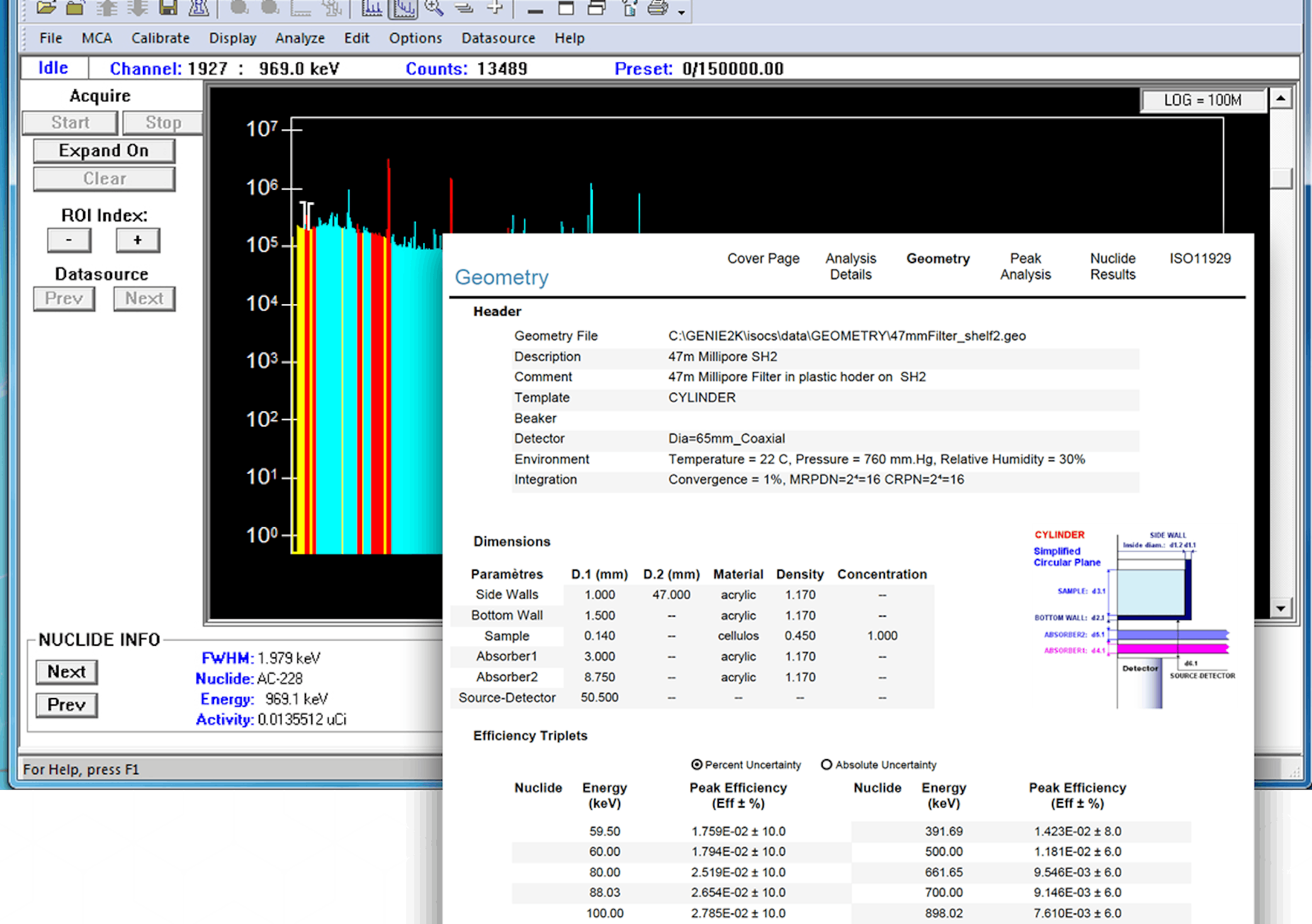
The software furnished with an in situ system is Canberra's Genie-PC software environment which offers extensive multitasking, user interfaces for both interactive and proceduralized operation and tools for extensive customization. These tools were used to create the PROcount counting procedures software - a fully implemented turnkey application for routine sample counting.

The menu structures of the PROcount software are serial in nature, guiding the user through each operation step by step - rather than presenting a complex array of choices at all times. They lend themselves to consistent operation by procedures and can be operated by non-spectroscopists with minimal training.

The menus also are graphical in nature, presenting the operator with an aesthetically pleasing and easy to read dialog. Operation can occur exclusively by mouse or keyboard, or by the two in combination.

There are essentially two classes of users on the system: those responsible for setup and configuration and those responsible for routine measurements. The user interface has been designed with a security system and two default security levels are provided: operator and manager. The user can easily reconfigure the system to offer a more extensive security arrangement with multiple levels. The operator is assigned a class of operations for routine measurements while the manager is assigned the capability to perform setup operations.

The counting procedure software provides a total environment for the application. In addition to taking standard measurements, the procedures provide a guided user interface for calibration operations, and quality control. Plus, under management level security, setup functions are provided.

When the operator selects sample counting, the system presents a list of available sample types. The sample type embodies the analysis protocol, counting time, parameter entry screen, and geometry.

When the sample type is selected, the system prompts the operator for the geometry, then to place the sample in position. Acknowledgment of that screen starts the count and a sample parameter entry screen is presented to the operator. The operator fills in the sample ID and other information that may be essential for the analysis. This screen can be different for each sample type possible, thus allowing the system to prompt only for the information required by a specific assay.

When the acquisition is finished, the spectrum is analyzed automatically and the spectrum, the measurement conditions, and the analysis report is written to disk. The report can also be sent to the screen, to a printer, or to both.

Selection of the quality assurance procedure leads the operator through a step by step operation to count and analyze a check source and store the results in a QA file. Typical systems use 60Co and 137Cs check sources and monitor peak position, FWHM and reported peak areas. The system accumulates a historical QA database from which graphical control charts and reports can be created, monitoring the performance of the system.

In Situ System Calibration

The proper application of in situ gamma spectroscopy requires accurate calibrations. Variations in terrain, ground cover, other sources of radioactivity, etc. affect the accuracy of field counting. Proper efficiency calibration factors must be applied to the measured radionuclide spectra that accurately reflect conditions on the ground.

Canberra's detector calibration technique for in situ gamma spectroscopy combines a reliable, proven and widely used mathematical calibration method with a Canberra-developed validation protocol to provide more accurate calibrations for a variety of detector/source combinations.

Using these new detector calibrations, Canberra in situ gamma spectroscopy systems are supplied ready to count as received, with calibrations pre-loaded, documented and validated. The calibration is detector-specific and provides calibration information for 34 standard soil distribution configurations.

Other techniques that use standard generic detector parameters are very limiting as they only work for the assumed simple exponential soil distributions. And they are only guaranteed to work accurately for detectors that are similar to those used for developing the generic parameters (detector size up to 40%, gamma energies between 300-1500 keV). This is a serious drawback for users involved in accident response where low energy medical isotopes or transuranic isotopes may be encountered. Much of the decontamination work today also involves uranium, where many of the most useful energies are from nuclides with low-energy gammas. The limitations caused by generic calibrations also cause problems for users wanting very high sensitivity or short counting times and therefore large detectors, or detectors with diameters larger than the length, as these detectors are beyond the range of most generic calibrations.

Even if there are also high-energy gammas to use, the combination of accurately using both low and high energy photons from the same decay scheme allows some more powerful tools to be used. For example, the activity can be calculated based both upon low and high energy gammas. If both agree, this gives confidence about the adequacy of the calibration model; if not, perhaps this indicates the presence of a buried source.

Other computer programs or calibration processes that do not use detector specific calibrations should not be used with large detectors, nor for energies lower than 200 keV. Even if the rigorous calibration techniques of EML-400 are followed, this still results in a calibration that is specific for semi-infinite plane soil calibrations with a detector height of one meter above the ground. All other calibrations must be independently performed using some other technique. With Canberra's detector calibration, the detector has already been successfully modeled, and additional calibrations can be easily added in the future. Since we have a precise model of the detector, we then have the capability to model and calibrate nearly any detector/source combination that the user may need in the future for unusual geometries, for accidents, etc. The mathematical calibration generally costs far less than full source-based calibration approaches, yet has comparable (or better) accuracy.


Types of calibrations delivered with turnkey in situ systems.

Validation of the Mathematical Model

Mathematical calibrations are performed using the Monte Carlo Neutron-Photon (MCNP) model developed 25 years ago by Los Alamos National Laboratory for use in nuclear weapons designs. This well-known and broadly used program is constantly refined and updated to reflect current physics data.

Canberra has validated MCNP for gamma detector calibration using 18 different detector/source geometries and detector types. Each detector/source combination was calculated using MCNP and then the calibration was verified using real detectors and sources.

Detectors used included both sodium iodide (large - 3 x 5 x 16 in.) and germanium (both N and P type). Geometries ranged from simple point sources to complex sources, such as 55-gallon drums filled with low- and high-density matrices and non-uniform sources.

Several valuable insights emerged from the validation program.

  1. We identified key parameters about the detector, the detector mounting structure, and the endcap to accurately measure during the detector manufacturing process. For best results, the model needs measurements that aren't recorded for normal detectors.
  2. We determined the necessary degree of detail to enter into the model to accurately describe the source geometry.
  3. We identified the optimum MCNP code parameters to use for the calculations.
  4. We created several programs that speed the calculations up but do not affect the results.

Based on the results of the validation program, we have confidence that the mathematical calibrations provided by the MCNP model are accurate to ±5% for simple geometries; ±10% for normal geometries; ±15% for complex geometries. For in situ soil measurements, the calibrations are within about ±10% over the energy range of 60-3000 keV, if the radioactivity is distributed as modeled.


Typical calibrations for 1 meter height.

Configuring Systems for In Situ Gamma Spectroscopy of Soil

Canberra's detector calibration service is designed to select the best combination of components for integration into gamma spectroscopy systems for in situ soil counting. The service eliminates the tedium of calibrating detectors and eliminates errors associated with older methods based on "standard" detectors.

When a complete system is purchased from Canberra, a factory tested and assembled field gamma spectroscopy system is delivered ready to count. It will include factory-loaded calibration equations, libraries loaded with common nuclides for environmental analyses, and analysis parameters recommended for use. The PROcount user interface environment is set up to access the geometries and source-detector distances described on the next page.

Canberra selects the best detector available for the intended application. For environmental measurements of photons with energies greater than 60 keV, the recommended detector is a large P-type coaxial; for applications that also include nuclides with energies less than 60 keV, the recommended detector is one with a thin entrance window (XtRa or N-type coaxial). Special measurements are taken during manufacture and assembly of the detector as indicated by the MCNP model and Canberra validation program in addition to other detector parameters normally recorded. These measurements help achieve the most accurate mathematical modeling results.

For each gamma spectroscopy system, detector calibration data points and plots of energy vs. efficiency are computed for the 10 standard geometries as follows:

Calibration

  1. Point source at one meter, on axis. Used for verification of detector model.
  2. Point source at one meter, 90 degrees from axis. Used for verification of detector model.

The following calibrations are for a semi-infinite plane source, one meter from the detector.

  1. rL = 0.1 g/cm2 and rL = 0.3 g/cm2. Used for fresh fallout where all the radioactivity is on the surface.
  2. rL = 1.0 g/cm2 and rL = 3.0 g/cm2. Used for aged fallout on wooded or desert sites.
  3. rL = 10.0 g/cm2 and rL = 30.0 g/cm2. Used for aged global fallout on open undisturbed fields.
  4. rL = 100.0 g/cm2 and rL = infinity g/cm2.Used for natural radioactivity uniformly distributed with depth.

Note: L is the relaxation length of the exponential nuclide distribution in soil; e.g. the distance over which the concentration is reduced by a factor of 2.71. However, since this requires different calibrations for various soil densities, the use of relaxation mass (rL, where r=density) of L is more conventional. For comparison to EML terminology, alpha is the inverse of L.

Twenty four additional calibrations for exponential and uniform distribution at each of the distances of 2.0, 3.0 and 10.0 meters above ground are provided as well. Calibrations at these additional heights allow the user the flexibility of increasing the height of the detector to cover more ground area in a single measurement. Comparisons of the calibrations at 0.7, 1.0, and 1.3 meters are also presented and are used to demonstrate the degree of precision of height positioning necessary.

Calibrations 1 and 2 are performed based upon the full MCNP method. The other eight standard calibration geometries and the 24 additional calibrations mentioned above are performed based upon a combination of the Monte Carlo MCNP model and the EML numerical integration model, and confirmed by the Canberra validation program. Since purely mathematical calibrations could have undetected errors, calculations for each Canberra detector are also validated with two physical measurements at geometries 1 and 2 using a multi-energy source. This assures Canberra and the user that the correct detector model was used. The result is an exact calibration for a specific detector, not a "standard" detector extrapolated from other detector parameters.

A report of the calculations and measurements performed will be provided. The report includes:

  1. Detector identification.
  2. Detector physical parameters used in the mathematical modeling calculations (except for some proprietary information which will be in the model but not supplied).
  3. Summary description of the mathematical calculation technique used.
  4. A comparison between the pure MCNP and MCNP-EML calibration techniques.
  5. Calculated energy-efficiency data points and graphs for each geometry.
  6. Results of the validation measurements (at no charge only if the detector is supplied with the order).
  7. Insertion of these parameters into the analysis software (if computer/MCA/software are a part of the order).
  8. Recommended libraries and analysis parameters for Canberra software (if computer/MCA/software are a part of the order).
  9. Recommended techniques for performing field gamma spectroscopy measurements.
  10. Reference document summarizing the validation tests of MCNP done to support the Canberra detector mathematical efficiency calibration technique.

Upgrading Systems with Existing Detectors

When preparing a new turnkey system for delivery, Canberra has complete control over and knowledge of the included detector. If an existing detector is to be used, many of the benefits of the MCNP calibrations apply, but at somewhat degraded accuracy. The system will still perform better than methods assuming a "standard" detector, as actual detector information is included in the calibration.

If the detector to be used was previously manufactured by Canberra, the parameters recorded for that serial number detector will be used to achieve the most accurate mathematical modeling results. However, since there are additional parameters that are needed for optimum accuracy that are not normally recorded, the accuracy will not be as good as for a detector specially manufactured for this purpose. If the detector is returned, we will also do the physical validation measurements for the calibration, comparing the calibration of the point source with the calculations.

If the detector to be used was supplied by another manufacturer, the customer must provide all the required detector parameters to Canberra for use in the mathematical modeling process. While we know that the results will not be as good, they probably will be as good as any other technique. If the physical validation measurements indicate a problem with the dimensions supplied, we can also do additional modeling or physical verification to achieve the most accurate result, but there will be an additional charge.


Ge detectors in narrow diameter cryostats (ACT-1) can be used to determine nuclide
concentration at various depths.
Results will be by specific nuclide without interference from other nuclides
(e.g. natural radioactivity).

In situ techniques for sub-surface contamination.

Beyond Soil Contamination Measurements

Although the detector calibration service was specifically designed for in situ soil contamination measurements, the MCNP model is especially useful for any other source geometries that can be accurately described.

Canberra can calibrate other geometries readily since the hardest part - the detector construction details - have already been modeled. Consult the factory with your specific needs. Examples of other situations that may be of interest for future calibrations:

It may be desirable to only measure the ground in a limited area under the detector. Canberra can supply a collimated detector and create an additional set of calibrations.

Often the ground being measured does not fit the standard model (an infinitely wide and thick plane of flat soil). It may have vegetation or the activity may be in a limited area such as the bottom of a trench. These geometries can be modeled and additional sets of calibrations supplied.

The user may want to add a flexible shield/collimator/detector holder to allow reduction of the potential interference from radioactivity in other objects. This can be added to the model.

For decontamination estimates and/or accident investigations, the system (preferably with the shield/collimator/holder) can be used to quantify the activity in pipes, barrels, walls, ceilings, and complex shapes. Calibrations for these can be developed.

Various samples shapes, such as Marinelli beakers, bales of hay, crates of tomatoes, tank cars of milk, etc., can be modeled and calibrated.

Detectors with small diameter cryostats can be lowered into holes and qualitatively and quantitatively measure the radioactivity around the detector site. This can be used for concrete borings, of shallow wells to investigate sub-surface contamination pathways.

Advantages of the Canberra In Situ System

Canberra's configured, tested, and calibrated system for in situ gamma spectroscopy offers several advantages:

  • All items are integrated, and tested by the factory to test for proper operation.
  • Using detectors manufactured for this application and using the detector-specific calibration approach results in more accurate calibrations.
  • Calibrations are provided for various source distributions and detector heights, unlike other approaches that are valid only for a single geometry and source distance.
  • The MCNP program permits modeling virtually any detector/source combination.
  • Costs are far less than full source-based calibrations, yet provides comparable accuracy.
  • The PROcount software is easy for technicians to learn, and is adequately protected to insure the validity of the results.
  • Canberra can deliver a complete system for in situ gamma spectroscopy that is ready to count soil as received.

Ordering Information

(Requires compatible computer)

GC4020: Coaxial Detector, 40% relative efficiency, 2.0 keV resolution.

7935-2: Multi-Attitude Cryostat, two day holding time.

7413: Heavy duty tripod.

1200: InSpector MCA.

C1711-10: Composite cable between InSpector and detector.

702: System Carrying Case (holds everything except the tripod).

D-2: Portable detector LN2 filling device (allows filling without special pressurized Dewar).

S401C: Genie-PC Gamma Analysis Option.

S405C: Genie-PC Quality Assurance.

ASD-INT: Integration and testing of hardware and software.

MCNP01: MCNP calibration and testing for in situ soil measurements.

2324: 137Cs and 60Co calibration check source (for field daily checks).

SU-455-5: Training, Environmen- tal In Situ Measure- ments using the InSpector, five day course in Meriden for one person.

Minimum Computer Requirements:

The system requires a notebook computer with at least a 486 class processor, 8 MB memory and 120 MB hard disk. Contact Canberra for currently available models and specifications.

If the computer is a part of the same order, the software will be fully configured, and the calibrations will be loaded into the PROcount software. Otherwise, these tasks must be performed by the user.


View full version of this Application Note (PDF)

Top of Page


Product Inquiry / Request

In the United States
(800) 243-3955

Outside United States:
(203) 238-2351

Reference Material