


Ge Clover Detectors


View full specifications (PDF)

Features

  • Clover DetectorHigh photopeak efficiency in ‘add-back’ mode
  • Good energy resolution
  • Good timing response
  • Reduced vulnerability to neutron damages
  • Reduction of Doppler broadening even more improved when using segmented crystals
  • Good sensivity to gamma ray polarization.

Description

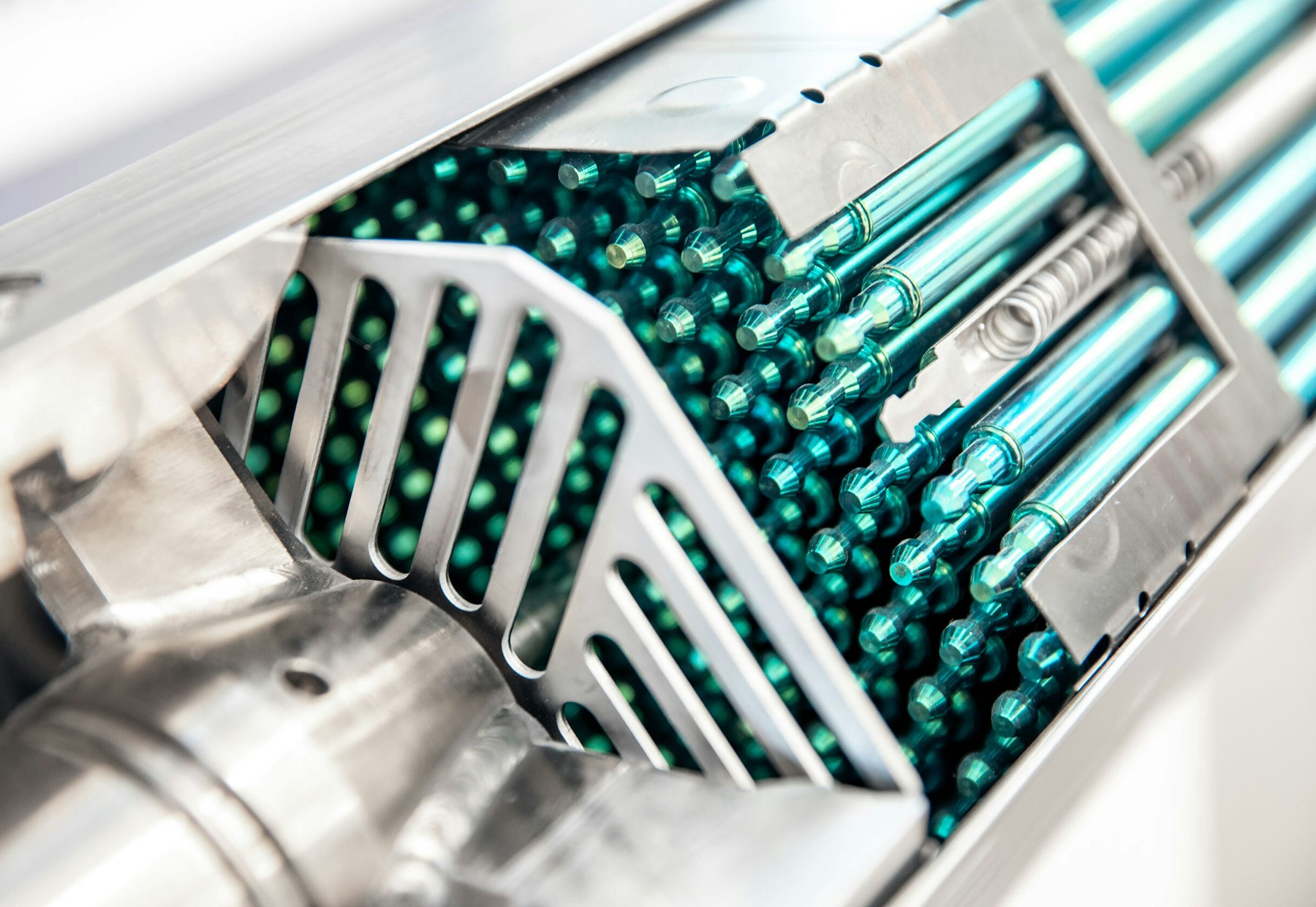
In the CLOVER detector assembly, the crystals are hold only by the rear side thus reducing the quantity of material surrounding the crystal and improving peak to background ratio. Moreover, crystals are packed very closely together to improve the add-back factor (Ge to Ge distance is typically 0.2 mm).

The four crystals are mounted in a common cryostat with tapered squared and cap. Distance between cap and crystal has been reduced to 3.5 mm to improve the solid angle.

A major advantage of a CLOVER detector consists of its high absorption efficiency : results are not only four times those obtained with a single crystal but, as crystals are mounted without any additional absorbing material, the full energy of a photon Compton scattered and absorbed in a second crystal can be determined. The full energy peak can be obtained by summing ("add-back") the energies deposited in the N segments firing.
The "Add-back" efficiency is then superior to the sum of the four individual efficiencies.

In the EUROGAM CLOVER detector (dia. = 50 mm, l = 70 mm), the mean relative efficiency (epw)m of a crystal is between 20 and 21 %, whereas the total relative efficiency (epw)tot in 'addback' mode is between 120 and 130 %.
The energy resolution of the four shaped crystals is typically less than 2.1 keV at 1.33 MeV and 1.05 keV at 122 keV. In add-back mode, the energy resolution is still excellent : 2.3 keV at 1.33 MeV.
Similar resolutions have been obtained with larger CLOVER than the EUROGAM detector.
The arrangement of several small crystals induces other advantages in comparison with a large single crystal :

  • The reduction of the crystal opening angle permits a Doppler broadening reduction.
  • The sensitivity to neutron damages is also reduced.
  • The timing response of each individual crystal, measured with a 60Co source in coincidence with a small BaF2 scintillator, is very good. Average FWHM is 5 to 6 ns and FWTM/FWHM is about 3.0 for a 50 keV energy threshold and a DFC delay of 30 ns.
  • The CLOVER can also be used as polarimeters due to the presence of four crystals.
The CLOVER detector offer has regularly been improved during the 10 last years; first by increasing the total CLOVER efficiency with the use of crystals of larger volume, then by improving the granularity of the device to enhance the detector resolving power.
Granularity qualifies the number of independent cells constituting the detector. First CLOVERs had a granularity of 4 crystals. A 2 or 4 fold longitudinal crystal segmentation drastically increases that granularity.
Such detectors allow an important reduction of gamma ray broadening due to the Doppler effect. Moreover, the use of internal and external contacts of the crystal (in case of detector segmentation) gives us an interaction position information:
  • Vertically and transversally by analyzing signals induced by the mirror charge
  • Radially, by making a pulse shape analysis

Accurate location of the interaction points allows not only reduction of Doppler broadening, but also gamma ray tracking in the detector.

Some cryostats have been designed to optimize the total resolving power by adding a BGO detector ('back catcher') at the rear face of the crystal.
Moreover, the maintenance of such tools has been simplified for the users: easy access to the cooled efficiency transistor offers on site replacement possiblity.

CLOVER detector dewars are smaller and allow:

  • compact arrangement covering nearly 4P,
  • positioning in all directions

… while ensuring a full 1-day filling autonomy.

Other clovers have been designed, the 'well' type for example, allowing measurement of large samples with an angular covering of almost 4P:

  • samples with an angular covering of almost 4P :
  • Useful diameter :
  • 35 mm High resolution High absorption efficiency at the middle of the well.

View full specifications (PDF)

Top of Page


Contact Us
Email Us or via phone

In the United States
(800) 243-3955

Outside United States:
(203) 238-2351

Online Quoting
Reference Material