


RadSentry™ Security Portals for SNM and Other Radionuclides
Features
Detection of gamma and
neutron radiation to low levels
- gamma-only version also
available- Modular architecture allows easy expansion and integration for a range of subjects (pedestrian, cargo, train...)
- Large area gamma-ray scintillators, sensitive to photons from 25 to 3000 keV
- Large volume 3He neutron detectors with albedo neutron cavity for optimum neutron capture
- Low false alarm rate, 1:1000 to 1:10 000 depending on background radiation and desired sensitivity
- Gain stabilization and spallation neutron rejection (patents pending)
- Continuous background monitoring with minimized background interference
- Speed correction algorithms
- Sequential Probability Ratio Test algorithm (SPRT)
- Alarm/annunciator panel displays status, annunciates alarms (visual and audio/MP3)
- Communicates locally and remotely via Ethernet connection or dial-up modem
- Operating temperature range -40 °C to +50 °C
- Certified for maximum wind loading and earthquake sustainability
- Three relays allow other devices to be driven from alarm states
- Can be integrated with CANBERRA Homeland Defense cameras
Description
The RadSentry™ family of portal monitors detects gamma and neutron radiation for purposes of stopping illicit shipment of Special Nuclear Material (SNM) and other radionuclides. While most of the new national and international standards require both gamma and neutron detection, gamma-only models are available. The unique concept of RadSentry is that each detection enclosure is a separate module with optimum gamma/neutron sensitivity. Detection modules can be connected in any configuration to achieve the necessary geometric efficiency. This allows for flexible system design where multiple panels can be deployed to maximize sensitivity for specific counting geometries. Each module is termed a Radiation Sensor Panel, or RSP. The simplicity of this design results in a safe, reliable, dependable, and configurable system to meet multiple detection applications.
Basic Configurations
A system is comprised of one or more RSP(s), a Control Unit, occupancy sensor(s), and an annunciator panel and/or a monitoring PC. RSPs are configured in various orientations to achieve desired sensitivity and performance for the application. Panels (RSPs) can be assembled to construct a pedestrian system, a four meter tall vehicle, cargo or rail system, and a five meter tall cargo or rail system. The systems are rated for heavy wind conditions and for the highest grade earthquake. The RSPs are shock mounted on bushings to reduce vibration.
The RSP
The building block of the system is the RSP, comprising neutron detectors and a single, large plastic scintillator. Monte Carlo N-Particle (MCNP) analyses were conducted to ensure the neutron moderator cavity and the neutron detectors are designed for optimum sensitivity. Two photomultiplier tubes (PMT's) are mounted to the polyvinyl toluene (PVT) scintillator in such a way as to reduce the non-sensitive volume of the cabinet. Gamma detector data is collected as a spectrum - i.e., energy vs. intensity - and further binned into eight Single Channel Analyzer (SCA) values, whose start and end energies can be programmed, thereby enabling Normally Occurring Radioactive Material (NORM) filtering or any other energy-dependent specification to be met. Event rates from each of the RSPs to the Control Unit are sent at least every 100 ms (state of health, power, tamper, high background, etc.).
The Control Unit
The Control Unit can be attached to the back of the first panel (as shown in the illustration) or mounted up to 300 feet away. The Control Unit supplies dc power and communication for each of the RSPs. Communication from the Control Unit to the RSPs is through CAT5 cable. The Control Unit analyzes all gamma/neutron data, stores alarm/occupancy data, and communicates with the outside world via RS-232/485 or Ethernet (cabled or wireless).
Monitoring Software
RadSentry portal software can be installed on any PC with an Ethernet connection. With this feature, all monitoring information can be logged and viewed from a remote connection. Management of multiple portal installations can be accomplished using CANBERRA's RADACS™ software (see separate specification sheet).
Occupancy Sensors
CANBERRA uses high-gain, active infrared (IR) occupancy sensors for detecting which is the best, most foolproof means of detecting the presence of an object and its speed in this application. Many tests have been conducted to ensure that this sensor performs well in various interfering conditions (rain, sleet, snow, RF, physical). The mounting of the sensors is designed to protect against security threats. Where the application calls for simple occupancy detection, one sensor set is deployed. In applications where speed information is required, two sets are deployed. While speed detection is not required on the pedestrian application, it is required for the vehicular application because the source can be located by relating the gross radiation signal to passage speed. For pedestrian monitors, an ultrasonic sensor is available.
Alarm Annunciation
RadSentry Software
The software has four operational modes:
Security level codes and password hierarchy restrict access to the portal. RadSentry software resides on any Microsoft® Windows® XP compatible PC with Ethernet connection.
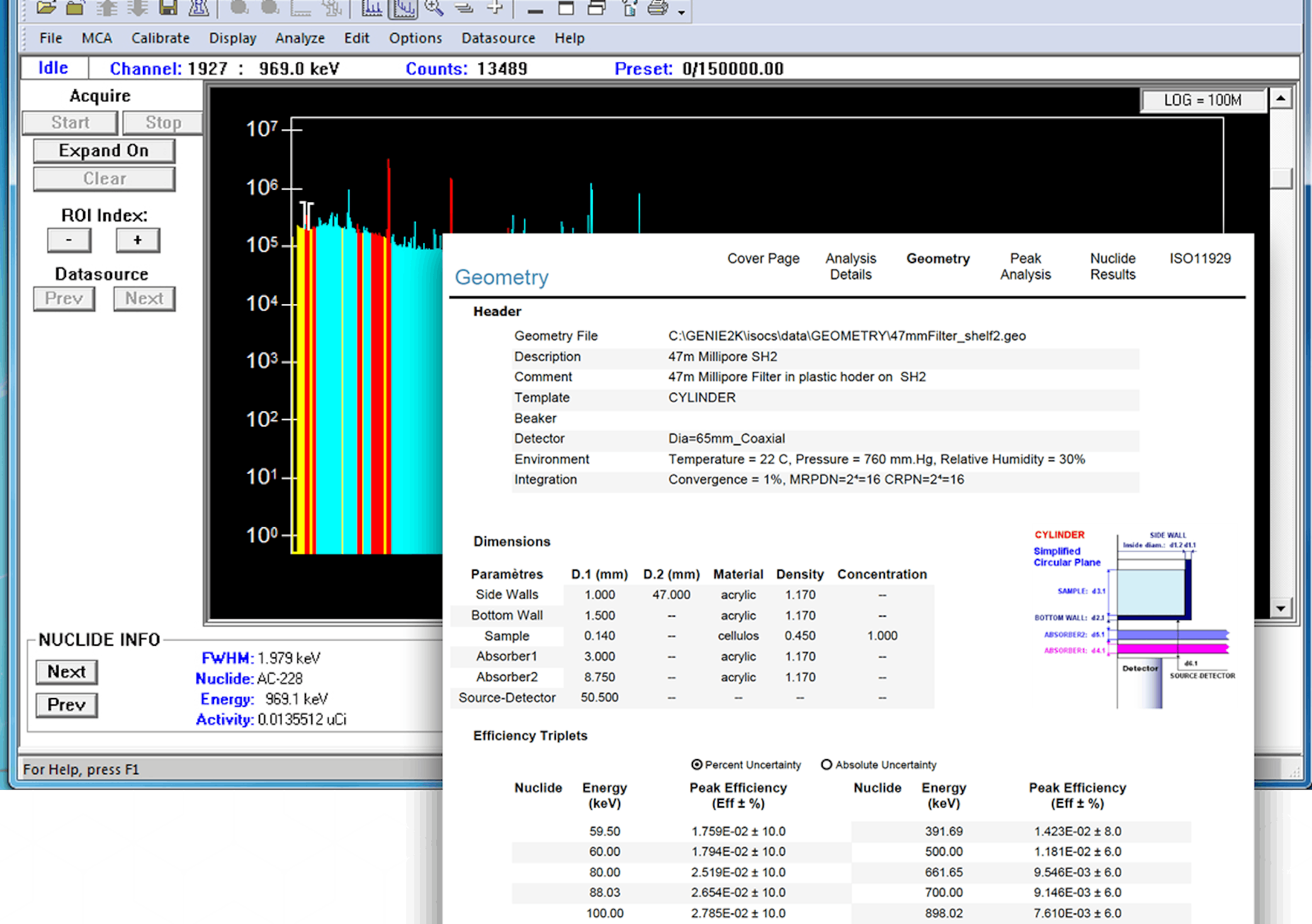
For the management of multiple portal installations, RADACS (optional) is the command/control platform of choice residing on the network. From within RADACS, RadSentry security portals and all other CANBERRA Remote Monitoring System (RMS) detectors are viewed in real time overlaid on a graphical map of the physical system layout. RADACS also encompasses an extensive database where historical data can be saved and viewed. |
Communications
All basic settings, including Calibrate and Test can be established at the Control Unit using a laptop computer connected to the video/keyboard ports. All portal parameters can be monitored, saved to files, and analyzed on a PC connected to the Control Unit. The Control Unit communicates to the outside world via RS-232, modem or Ethernet connection. Communications uses the RadNet standard, allowing RadNet-compatible software to be used in addition to the CANBERRA software. Third party devices can be supported within the standard architecture (paging system, weigh-in scale). The Control Unit also supports the CANBERRA Homeland Security camera system, which at the time of alarm, will save high-resolution images (pre, post, and during) of the violating object. For more information about this camera, please see its specification sheet.
Options
- Gamma-only systems are available.
- "Gate-out" circuit to allow operation concurrently with the new generation of the x-ray scanners
- RSP stands can be fabricated to mount the RSPs vertically (at different heights). The base heights conform to ANSI and/or ASTM sensitivity requirements.
- Specialized mount for temporary/moveable configuration
- Alternative configurations of RSPs can be designed to optimize counting geometry, sensitivity and cost for a wide range of subjects.
- Radiological Assessment Display and Control System (RADACS).
- Occupancy sensors for trains (rail car counting).
- Active IR occupancy sensor can be replaced by magnetic loop or ultrasonic sensors.
- Third-party annunciator alarms and sirens available.
- CANBERRA Defense camera/optical security system.
- Tailored Efficiency Performance (modified 3He tubes, plastic scintillator).
- UPS/Battery backup (standard options for 4, 8, 12 hours).
- Installation/training and Service Packs.
Sensitivity Specifications
The RSP design is flexible and thus, can be delivered to meet national, international, or local sensitivity specifications, whether static or dynamic. Geometric sensitivity is scaled by adding or subtracting RSPs. Absolute sensitivity of an RSP for gamma-rays is scalable by adjusting the SCA widths and/or the effective lower-level discriminator for separating PMT noise from low-energy Compton-scattered events. Absolute sensitivity of an RSP for neutrons is also scalable by adjusting the number of 3He proportional tubes and/or the fill pressure. As a result, the RSPs and overall system performance can be delivered to meet ASTM Category I, II, III, or IV SNM standards or ASTM Category NI, NII, or NIII SNM standards; or ANSI, ITRAP, IAEA, US Customs, and IEC requirements.
Company Information
CANBERRA has been manufacturing and deploying portal monitoring systems since the early 1990s. Historically, these systems were deployed to detect Special Nuclear Materials (SNM) at exits of nuclear facilities or to monitor for the inadvertent disposition of isotopes in scrap metal facilities or in solid waste landfills. One product line - the JPM series - was developed at Los Alamos National Laboratory (LANL) and the technology transferred to CANBERRA. Many of these systems were deployed worldwide for detecting nuclear proliferation activities. Another product line was developed in conjunction with the Commissariat à l'Énergie Atomique (CEA) and then deployed for the monitoring of waste facilities and general users of radioactive material.
In the aftermath of September 11, 2001, federal governments and international authorities have collectively begun the task of defining new standards for the monitoring of borders for illicit trafficking of nuclear and radioactive materials. Inspected objects include pedestrians, personal automobiles, transportation trucks, cargo trucks, shipping containers, air freight containers, and even airplanes and ships. To meet new demands, CANBERRA began the task of re-engineering and designing the "next generation portal monitor," the RadSentry. Like its predecessors, RadSentry uses high-quality, polyvinyl toluene scintillators to detect photons and 3He proportional tubes to detect thermalized neutrons. Building on this - the most cost-effective and reliable means to detect photons and neutrons separately - RadSentry uses state of the art electronics and software to offer a programmable, scalable, and multi-configurable architecture. RadSentry is designed to meet the standards for SNM monitoring and border monitoring equipment, as listed in the references section following.
RadSentry Security Portals for SNM and Other Radionuclides
The sensitivity specifications presented here are for a nominal RadSentry system, which is designed to meet ANSI N32.35, ASTM category II and NII (pedestrian), and US Customs specifications for portal monitoring systems (ref 6). Independent laboratory testing continues to certify sensitivity specifications. Sensitivity values are provided under the following test conditions:
- Background: Gamma-ray background of 10 μR/h.
- Background: Neutron background of <5 cps (system).
- Nuisance/false alarm rate: no more than 1:1000 occupancies (gamma or neutron).
- Source distance: closest approach to detector (0.5 meter pedestrian, 2.4 meter vehicle).
- Source shielding: none.
- Source neutron moderation: none.
- Source travel velocity: 1.2 m/s (pedestrian), 8 km/h (vehicle).
- Source activity certified to ?20%.
- Alarm probability of greater than 0.5 at a 95% confidence interval (ASTM C 1236-99).
Gamma or Neutron False Detection
False detection is when either a gamma-ray alarm is initiated by a neutron source or a neutron alarm is initiated by a gamma-ray source. The neutron detectors are insensitive to gamma radiation up to 10 mr/hr (100 μSv/hr), gamma. The gamma-ray detectors are insensitive to neutron radiation up to 50 000 n/s (neutron on contact). Estimated false detection rates in actual use is less than 1:10 000 alarms. Meaning, given 10 000 alarm conditions, only one will be misidentified as a gamma or neutron alarm.
Nuisance Alarm Specifications
RadSentry software includes an automatic test sequence that forces the system into repeated occupancies and background update periods. The nuisance alarm probability (also termed the False Alarm Probability) for the gamma-ray channel and the neutron channel is better than 1:1000 under normal test conditions (10 μR/h) and <5 cps at sea-level (neutron), using normal background update provisions. Background update algorithms are available to accommodate applications where background variation is time dependent. At alarm settings equivalent to four standard deviations above background, the system statistical alarm rate is 6 in 50 000 (just over 1:10 000).
Multi-Lane Monitoring
Identifying which object caused an alarm in a multi-lane application is enabled using CANBERRA RADACS software to manage multiple lanes, sequencing/triggering the alarm profile accordingly.
Alarm Trapping
In applications where throughput is back-to-back or monitoring flow is "high-speed", background update periods are settable to enable trapping and recognition within 800 ms of passage.
QUESTIONS? 
In the United States
(800) 243-3955
Outside United States:
(203) 238-2351


RadSentry host software is designed to provide a graphical
user interface for RadSentry portals. It is not required
for a fully-functioning system, but is recommended where
there is a need for user-friendly, software-controlled
monitoring and setup.
In addition to the RadSentry host software, low-level control
software (standard) is available directly in the Control
Unit. This software allows system experts to make all fine
settings to each of the detectors and associated nuclear
instrumentation on each of the RSPs.