


Spectroscopy and Data Management Software
|
|
||||||||
SYSTEM SOFTWARE INTRODUCTION
As the nuclear measurement
industry has matured and evolved into a wide range of critical
applications, the requirements for computer software have
evolved as well. Where years ago a spectroscopist might have
operated a hardwired MCA with its own user interface –
today the MCA interface is emulated in computer software. Where
he or she might have manually evaluated regions of interest for
nuclide activity information – today sophisticated data
reduction algorithms analyze complex spectra in the blink of an
eye.
Most importantly, the spectroscopy systems that were once operated only by highly learned physicists are now run by operating technicians. The techniques that were once the domain of researchers are now used in a wide range of routine, but critical nuclear measurement applications. Many facilities now take tens of thousands of measurements per year – each of which could constitute a legal record related to public or worker safety, nuclear waste management, environmental protection and the safeguarding of fissile materials.
No longer is it adequate to simply acquire a spectrum and produce a report – although this is still a key aspect of the successful application of the system. Today’s system must provide fully authenticated results.
The measurement record is a legal record. The operator of the measurement system must be able to prove that the system was properly operated, in a completely known state, by qualified personnel, for each measurement taken. The analysis facilities must be fully documented and verified – with a heritage that proves their capability for the specific measurement application at hand.
Finally, the site must be able to operate efficiently. User interfaces must be designed specifically for the application – providing the operating technician with a straightforward procedural operation that reduces the possibility of errors. Massive amounts of information must be managed, transmitted and reported – with little or no manual operation that could introduce errors.
The Genie Family
It is for this diverse set of needs that CANBERRA developed the Genie Family. The Genie Family lets you integrate a laboratory, or a set of laboratories, or multiple applications, in a single, cohesive architecture. You can network computers and MCAs, share information and distribute applications.
The Genie Family consists of the VMS based Genie-ESP, Windows NT/95/98 based Genie 2000.
What makes these products a family? Simply the ability to smoothly integrate all of them, and their resident applications, into a single system. No longer does the variety of applications require a set of “orphan” platforms, each distinct from the others. Instead of a group of individual systems, the Genie lab has a single system, with multiple operator workstations and multiple applications.
Specifically, the power of the Genie Family is the result of a number of common Genie Family elements.
Common Look and Feel
Whether the user chooses Genie-ESP or Genie 2000, the interactive human interface is consistent. The interactive operation has been made consistent across platforms with the exception of a limited number of unique features of a specific platform.
From a practical standpoint, this greatly enhances the ability of a user to choose the computing platform on the basis of its own intrinsic abilities. Users can move from a PC to a Digital Equipment Corporation Alpha processor without retraining or confusion. A knowledge of the operation of one system is equivalent to knowledge of both.
In addition to the common interactive user interface, all Genie Family members support robust batch procedure environments – enhanced by CANBERRA Graphical User Interface (GUI) tools. These allow for the construction of dedicated user interfaces for specific applications. Thus, the operator of a Genie based system for routine gamma sample counting, waste measurement, whole body counting or safeguards inspections has a user interface that is precisely tailored to the unique needs of that specific application.
Common File Format
All Genie platforms use the “CAM file” format, a unique data structure which enhances the user’s ability to transport data and verify the integrity of the complete system. With the CAM file, measurement records collected on one Genie based system can be transported to another for reanalysis, review or archival – as all use the same format.
In addition to the ability to transport data, the CAM file offers other advantages. In traditional spectroscopy systems, data, calibrations, header information, parameters, results and reports were often maintained in separate files. This created formidable problems in managing data reconstruction of an analysis months after sample counting involved a reassociation of all the right files.
With the CAM file approach, the data file is the complete sample record. Data, calibrations, results, analysis parameters, front end setup parameters and the library are all stored as part of the file. No longer does the user have to keep track of an array of files and locate all the right structures to revisit a sample. Most important, the user can open any sample file and immediately have a complete record of the measurement and the state of the measurement system at the time the sample was counted. All parameters – front end setups, nuclide library contents, calibrations in effect at the time of the count and operator names –are there in the single file sample record. This makes it quite easy for the system user to verify to auditors or legal staff that the system was in a known state at the time of the measurement.
CAM files are extensible data structures where the information within the file is controlled by pointers and a defined schema file. Access is performed via access routines, simply specifying the name of the CAM variable to be read from the file. The user doesn’t have to perform complicated operations to extract data.
Network Operation
Many facilities have grown over time to the point where a variety of computing platforms are in place. Some are migrating from VMS based to PC based systems as the power of personal computers increases. Others are migrating from PCs towards VMS solutions as their expanding requirements call for greater system security, access and management capabilities. Still others wish to adopt a hybrid, selecting each platform on the basis of its specific merits for the application.
Whatever the combination of VMS and PC platforms, if they are configured with Genie Family capabilities, the individual workstations can be combined into a single, cohesive, seamlessly integrated system. Using an Ethernet network and appropriate networking software, access can be granted to information, even live spectral data, from anywhere on the network.
Supervisors can monitor lab operations from their offices without going to the lab. Centralized file servers can be configured to provide a central repository for all information in a diverse lab. Information from many platforms can be consolidated and manipulated by comprehensive laboratory database software. A data review station can be configured with an array of sophisticated analysis tools to review routine count and analysis results from other platforms.
Common Analysis Algorithm Set
Genie platforms have a formidable collection of analysis algorithms a collection that continues to grow. This allows algorithms to be selected that are optimized for specific applications or specific sample types.
Additionally, a subset of key algorithms have been identified as “common” between all platforms a set that will also continue to grow. The common algorithm set has been selected on the basis of two primary criteria, their broad applicability to a wide range of applications and their representation of the state-of-the-art in analysis capability. These algorithms have been fully documented and discussed in open scientific literature and are widely accepted.
By selecting these common algorithms, a laboratory can be assured of consistent results, even across widely differing hardware platforms. Of course, this does not preclude the use of specialized or historical algorithms in either platform where required by your applications or procedures.
Instrument Quality Assurance
In the increasingly regulated environment of spectroscopy applications, it is no longer sufficient to simply produce quality results. Many facilities must be able to prove the quality of their results. They must prove that the system was properly calibrated and maintained at the precise time the sample was counted and analyzed.
A major aspect of this quality trail is the instrument Quality Assurance capability available for the products. The QA packages allow the user to track any variable in the CAM data structure. FWHM, peak centroid locations and tail factors can be tracked. Additionally, more esoteric values can be tracked in the QA database such as front end setup parameters and manually entered parameters.
As with many other Genie family capabilities, the QA packages have been designed for commonalty. The look and feel of the QA Editor provides a consistent operation between platforms.
Genie-ESP
Genie-ESP is the flagship of the Genie Family. Based on the powerful Alpha family of RISC processors from Digital Equipment Corporation, Genie-ESP offers the industry’s highest level of capability.
Genie-ESP is based upon a system architecture that has been evolving since the mid-1980s. As such, continuous enhancements have left the Genie-ESP with a rich set of applications and capabilities. Application specific software is available for gamma spectroscopy, alpha spectroscopy, in vivo counting and nuclear safeguards. Additionally, a wide range of peak searches and other analysis algorithms make Genie-ESP the choice where a diverse set of needs dictate varying approaches.
The underlying VMS architecture of the Genie-ESP offers the large facility unsurpassed capabilities in terms of multi-user security and access control. One of the major concerns of facilities handling large amounts of data is the possibility of accidental or malicious intrusion into the computer systems altering or destroying irreplaceable information. With a true multi-user system, the system manager can configure various levels of access to individual system resources files, front end electronics, MCAs and effectively lock out unauthorized access.
For example, where ICB NIM is used, a user may wish to limit access to front end settings to personnel with an engineering password. Or access to libraries and calibration certificate files may be limited to supervisors. Access to sophisticated data review tools such as interactive peak fit packages may be restricted to an analyst or staff physicist. Certain technicians may be granted access to some detectors, but not others.
All these controls are intrinsic to the VMS operating system underlying the Genie-ESP software.
In addition to analysis capabilities, the Genie-ESP supports several application database packages such as OpenCDM Chemistry Data Management Software (OpenCDM), Effluent Management Software (EMS), Countroom Analysis System (CAS) packages and Health Information System (HIS-20). These packages tie together acquisition and data analysis from Genie-ESP systems, Genie 2000 systems or both to provide comprehensive information management and analysis capabilities.
With the power of the Alpha hardware, the Genie-ESP offers the best solution for performance critical applications. Fast CPU speeds, virtually unlimited disk and memory availability, and high resolution graphics are all advantages of Genie-ESP.
Genie 2000
Traditionally, personal computer based systems have been limited by constraints in the underlying software environments. Single tasking implementations, even when enhanced by windowing software, and memory manipulation features are still fundamentally limited.
Genie 2000 was designed to break these limits. Based on a totally modular architecture, Genie 2000 is designed to take full advantage of today’s Microsoft operating environments – Windows NT and Windows 95/98. Unlike packages from other suppliers, Genie 2000 is designed to fully exploit the full power of 32 bit software with true multitasking.
The advantages of the Genie 2000 architecture become apparent as we consider the various aspects of today’s spectroscopy systems. As observed earlier, many laboratories have been expanding capacity. In some cases this means adding detector inputs to existing systems, in others it means adding complete computer systems. Either way, the multitasking nature of Genie 2000 provides real benefits.
With a multi-detector system, applications generally call for the ability to operate with true independence. Users need to operate detectors on different geometries for different sample types and different count times, without regard for the other count procedures that may be running in the system at the same time. They need to operate without collisions and slowdowns in the software. They need to be able to pull up an interactive analysis session at any time without interrupting a count procedure that may already be running.
With a single tasking system, meeting these needs is difficult to impossible. Add to this the complications of multiple systems, performing real time data acquisition and analysis over networks, and multitasking is an unquestionable necessity.
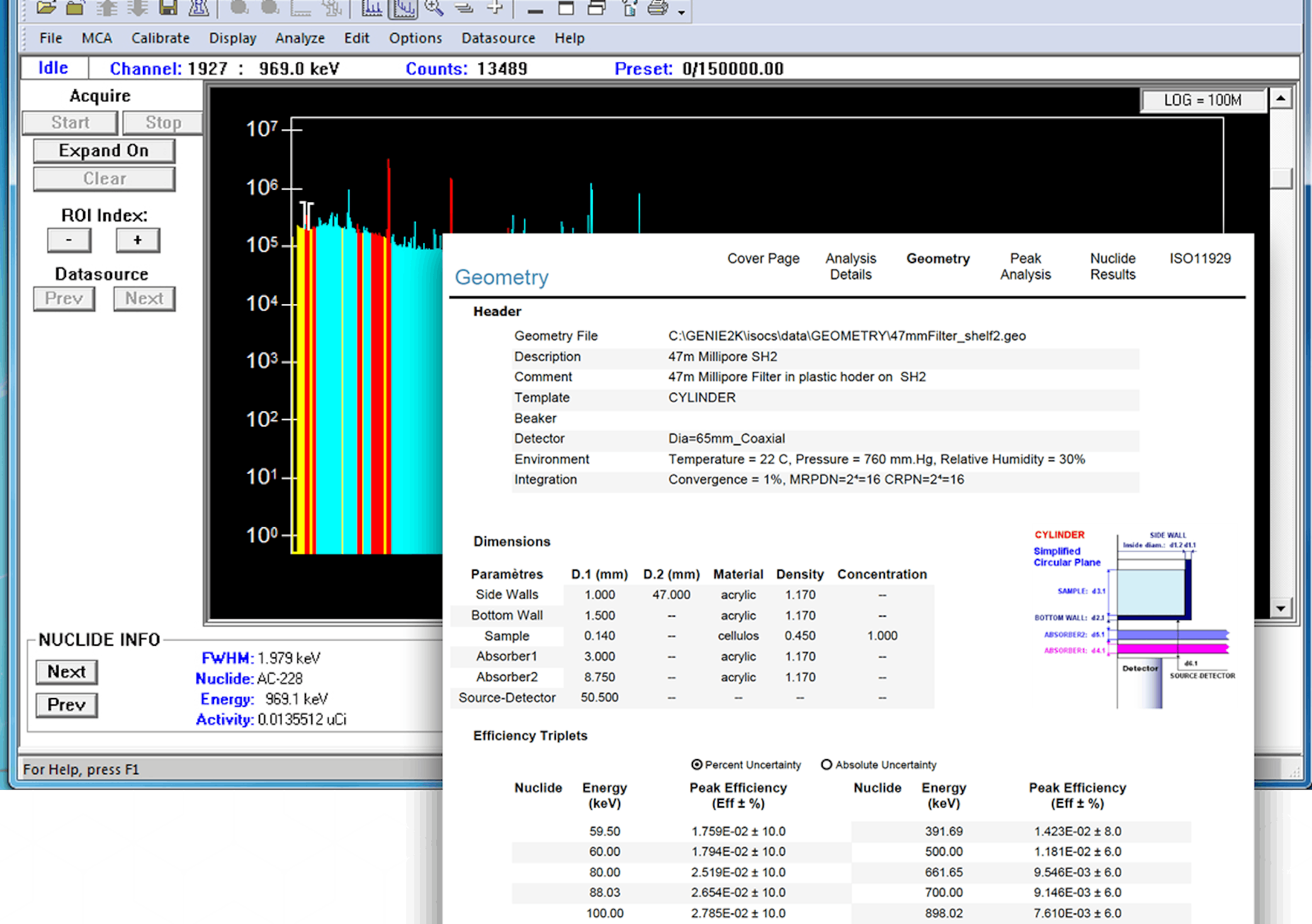
Even in a stand-alone single detector system, the advantages of this capability comes through. Genie 2000 tightly integrates the two key aspects of a spectroscopy application, acquisition and analysis, into a unified graphical interface. Yet while complex counting operations are in progress, the user can analyze data files, access library editors, spreadsheets or other applications.
Genie 2000 support for acquisition hardware, like the Genie-ESP, extends to the AIM and ICB NIM, allowing network systems to be assembled with redundant and remote capability. Additionally, the Genie 2000 lets the user with an existing investment in board based acquisition hardware (AccuSpec or System 100 boards) retain the investment and still gain the benefits of a more powerful platform.
Whatever the application, you can look to the Genie family for the ultimate in performance, capability and flexibility.
|
| Top of Page |
Related Products