



REGIONAL ACCESS

EXTRANET ACCESS

Genie™ 2000 Gamma Analysis Software
For more detailed information click here  > >
Product Spec Sheet PDF Format

Features

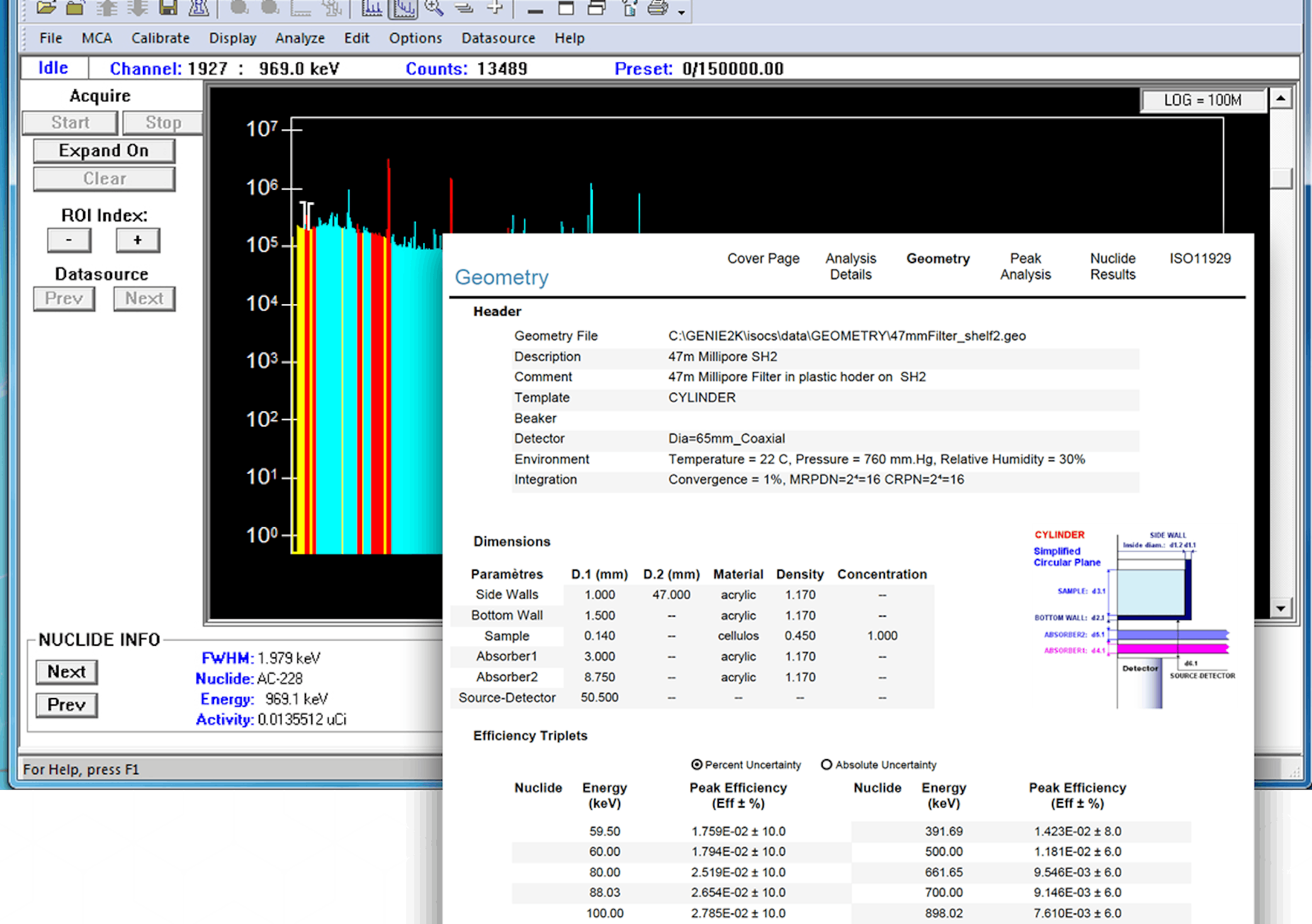
Figure 1 – Interactive Analysis.
  • New: ISO11929 compliant
  • Full gamma spectrum analysis when used with Genie 2000 Basic Spectroscopy Software
  • Interactive Spectral Analysis
  • Efficiency correction
  • Nuclide identification and quantification
  • Library Correlation NID peak locate with background compensation
  • Interference correction and weighted mean activity calculations
  • Patented true coincidence (Cascade) summing correction
  • 3-Dimensional Geometry Composer for interactive definition and visualization of sample, detector, and absorber parameters
  • Parent/daughter decay correction
  • Background subtraction and reference peak correction
  • Minimum Detectable Activity (MDA) calculations
  • Automatic Gain Adjustment
  • Post NID processing options including:
    • Action/alarm level checking
    • The Line Activity Consistency Evaluator (LACE)
  • All functions accessible through interactive, batch or S560 Programming Library environments

Description

The Genie 2000 Gamma Analysis Software package includes a set of advanced analysis algorithms for further processing of gamma spectra acquired via the Genie 2000 Basic Spectroscopy Software. These algorithms provide a complete analysis of gamma ray spectra obtained from any type of gamma detector. The software is based upon time proven methodologies that have a long history of acceptance and refinements, and it includes patented1, ground-breaking analysis and calibration techniques.

The gamma analysis algorithms supplied are accessible from the Genie 2000 interactive environment, the batch procedure environment or the S560 Programming Libraries. Analysis execution utilizes data resident in the Configuration Access Method (CAM) data structures native to all Genie Family systems. Results from each algorithm are also stored in CAM files, making the resultant data file a complete record of the entire analysis. This unique method of data storage greatly simplifies system administration, data transfer, data archiving, and any necessary reanalysis of archived spectra at a later date.

Interactive Spectral Analysis

The Interactive Analysis feature (Figure 1) allows the user to visually inspect a spectrum for multiplet peaks and/or peaks not found to be statistically significant in order to refine the analysis. Analysis results can then be modified by interactively adding, editing, and deleting peaks and peak regions based on the detailed spectral information that is provided. Calibrations and nuclide libraries can also be reviewed and updated, if necessary, from this software module.

The analysis results plot below the spectral display provides an intuitive view of the following user-selected parameters:

  • Peak Significance - shows the negative of the peak significance data resulting from an Unidentified Second Difference analysis of the spectrum. The negative is used to make it easier to visually correlate the spectral peaks with their significance; a large significance indicates a peak.
  • Peak Correlation - shows normalized peak correlation coefficient data resulting from a shape correlation analysis of the measured spectrum. A large correlation indicates a peak.
  • Peak Residuals - shows the difference in counts between the current peak area results and the measured spectrum.
  • Nuclide Residuals - shows the difference in counts between the current nuclide results for each peak and the measured spectrum.

The residuals in each channel are scaled by the uncertainty in the spectrum at that channel:

Formula - Measured value - Theoretical Value . . .

Efficiency Correction

Figure 2 – Efficiency Calibration Curves.

The efficiency correction calculation involves calculating a peak efficiency and its uncertainty for each of the found peaks. Genie 2000 supports three separate efficiency calibration models (Figure 2): Dual, Linear, and Empirical. The coefficients of all three models are calculated automatically at efficiency calibration time. A fourth interpolated plot method is also available which simply connects the various calibration spectrum data points to create a calibration curve. For efficiency correction in a sample, one has only to select which of the above models to use; or the proper model can be included as part of an analysis sequence for standard analyses.

Nuclide Identification and Quantification

The nuclide identification algorithms take into account all energy lines of a nuclide entered into the analysis library with their proper branching ratios, as well as the half-life of the nuclide. For a positive identification, a nuclide must have at least one gamma energy within the user-selected energy tolerance of an observed peak in the spectrum. Furthermore, a sufficient number of the other energies of the nuclide (if there are other energies) must also have matching peaks in the spectrum. The number of peaks that must be seen is determined by the sum of the branching ratios of the peaks with matching spectrum peaks as compared to the sum of the branching ratios of the peaks without matching spectrum peaks. Finally, the decay time of the measured spectrum must not be excessive compared to the half-life of the nuclide.

Nuclides that pass these tests with a confidence index greater than the user selected threshold will be classified as identified. For all identified nuclides, the algorithm calculates the value of the confidence index and a decay corrected activity per unit volume (or mass) for each energy with a matching peak in the spectrum. If applicable, the decay correction automatically includes a correction for decay during the acquisition as well as for decay from the sample date to the start of the acquisition. An additional decay correction is automatically provided for samples where the sample material is collected or accumulated over a finite period of time. Such samples include air filters, air cartridges and activation samples.

Library Correlation NID Peak Locate

This peak locate analysis engine additionally provides tentative nuclide identification and activity estimation results. It is added to the peak locate selections in the Genie 2000 Acquisition and Analysis Analyze menu upon installation of the S501 Gamma Analysis Option and is also available for use in the batch and S560 Programming Libraries environment. Benefits include the ability to accurately locate minor peaks, especially those hidden in multiplets, while also being able to correct calibration errors that might otherwise impair later nuclide identification analyses. This preliminary nuclide identification capability can be useful for applications in which a quick identification of the nuclides present in a sample is more important than a precise activity determination. Included in this engine is a background compensation option that is very useful for applications using LaBr3detectors, where the intrinsic background can be rebinned and subtracted out on a channel-by-channel basis. The capabilities of this peak locate engine are designed for compatibility with the ANSI N42.34² standard.

Interference Correction and Weighted Mean Activity Calculations

After standard nuclide identification, the spectrum can be analyzed for interference sets. An interference set is defined as two or more nuclides with at least one common energy; that is, a peak that has not been resolved into separate peaks by the peak locate and area calculation. The activities of such nuclides are calculated as a solution to a linear least squares equation.

The algorithm automatically finds the nuclides that have interferences – no special library is required. However, energies for nuclides can be marked in the library for exclusion from weighted mean activity calculations. The activity of a nuclide which is not part of an interference set is automatically calculated as a weighted average of the activities calculated for each of its peaks. The activity of a nuclide with only one peak and no interference from other nuclides is automatically calculated from its peak. Factors taken into account in the weighting of the peak activities include efficiency, area and efficiency uncertainty, and the branching ratios of the various peaks.

True Coincidence (Cascade) Summing Correction

Figure 3 – Comparison of Cascade Corrected toEmpirical Efficiency.
Figure 3 – Comparison of Cascade Corrected to Empirical Efficiency.

CANBERRA’s unique and patented Cascade Summing Correction feature¹ corrects your entire spectrum, from 10 keV to 7 MeV, against loss or gain of observable peak area as a function of nuclide decay scheme and geometry. It is the only CSC engine on the market that corrects for gamma-gamma, Xray-gamma, and positron annihilation-gamma summing effects. True coincidence summing can cause systematic peak area errors of 30% or more with certain nuclides and geometries (Figure 3). The Genie 2000 Cascade Summing Correction method uses LabSOCS™ technology to precisely describe the sample/detector geometry without the need for expensive and time consuming calibration using radioactive standards. A generic selection of germanium detector characterizations ensures that Cascade Summing Correction can be carried out for the majority of detector sizes without prior LabSOCS/ISOCS™ characterization. However, these characterizations, including more specific detector data, may be used if available.

Geometry Composer

Figure 4 – Geometry Composer.

The Cascade Summing Correction algorithm described above and the calibration algorithms in the optional LabSOCS or ISOCS calibration software require an accurate description of the counting geometry for each sample. The Geometry Composer (Figure 4) is a powerful tool allowing the interactive definition and 3D visualization of all geometry-related parameters including detector properties, sample dimensions and densities, and distances shielding between the detector and sample. The tool renders the geometry real-time in 3-dimensional space providing immediate visual feedback and allowing for quick error detection.

Additional features include custom beaker creation with or without absorbers, object isolation for focused design, object transparency for viewing of internal items, zooming, and more.

Parent/Daughter Decay Correction

The peaks observed in gamma spectra often originate from a nuclide’s ground state and its progeny. When the parent nuclide and its daughters are not in equilibrium, a correction must be applied to report proper nuclide activities. The Genie 2000 Gamma Analysis software includes an algorithm which applies such correction based on sample time, acquisition start time, elapsed acquisition live time and nuclide Parent/Daughter information contained in the nuclide library used for the analysis.

Background Subtraction and Reference Peak Correction

The background subtract algorithm allows the subtraction of environmental background peaks from sample spectra. The background spectrum must first be analyzed separately for its peak locations and associated areas. At the time of execution, the background subtract algorithm automatically scales its results to be proportional to the acquisition time of the sample. An energy tolerance to match the peaks in the sample and background spectra can be specified by the user.

The purpose of a reference peak correction is to use a reference peak in the spectrum (of a known count rate) to normalize the areas of all other peaks in the spectrum. The reference source can be either an electronic pulser or an external stationary source. Both a reference peak correction and an environmental background subtract can be applied to the same sample spectrum if desired.

Minimum Detectable Activity (MDA) Calculations

A Minimum Detectable Activity (MDA) can be calculated for both the radionuclides which have and have not been found in the spectrum. The MDA algorithms can perform Currie MDA or KTA MDA (used for German regulatory compliance) and LLD calculations. If applied to a spectrum collected with a blank sample, or in an empty shield, the MDA calculation is equivalent to a Lower Limit of Detection (LLD) calculation. The MDA confidence factor and constants are user-selectable. Also, the user can elect to apply variable ROI widths and cascade summing corrections to the MDA calculations.

Post NID Processing Options

Figure 5 – LACE Screen and Report for Cs-134.

These options include the Action/Alarm Level calculations and the Line Activity Consistency Evaluator (LACE). The Action/Alarm Level calculations can be enabled to provide alerts if activities or concentrations in samples (or whole body counts) have exceeded limits established by the user. Up to two alarm settings are available, and the limit values for the nuclides of interest are stored in the nuclide library.

The Line Activity Consistency Evaluator (LACE), as shown in Figure 5, can assist the user in evaluating the quality of the gamma analysis. LACE assesses the consistency between line activities calculated by the gamma assay for multi-line radionuclides. This is accomplished by calculating a ratio of the individual line activities compared to either the key line activity or the weighted mean activity (as chosen by the user) for each multi-line nuclide in the sample. These ratios are shown graphically versus energy, and an equation describing the displayed curve is shown just below the graph.

This information allows the user to identify possible discrepancies between the efficiency calibration and the actual sample counted. For example, a sample of higher density than the one used for calibration will result in a low reported activities bias, and the bias will be more pronounced at lower energies.

ORDERING INFORMATION

  • Model S501 Genie 2000 Gamma Analysis Software

OPTIONS

  • Model S574 LabSOCS Calibration Software
  • Model S573 ISOCS Calibration Software

1. U.S. Patents 6,225,634 and 6,228,664.
2. ANSI N42.34 Performance Criteria for Hand-held Instruments for the Detection and Identification of Radionuclides.
Genie, LabSOCS and ISOCS are trademarks of Canberra Industries, Inc.


QUESTIONS?

In the United States
(800) 243-3955

Outside United States:
(203) 238-2351

Privacy | Quality | Terms & Conditions | Webmaster