



Digital Signal Processing
CANBERRA Digital Signal Processing-based instruments offer excellent throughput for high count rates and stability for environmental site samples.
Products in category
Lynx® Digital Signal Analyzer
Description
The Lynx® is the most advanced, full-featured Multichannel Analyzer ever offered. It is a 32K channel integrated signal analyzer based on advanced digital signal processing (DSP) techniques. When paired with the computer of choice, the Lynx becomes a complete spectroscopy workstation capable of the highest quality acquisition and analysis. The instrument supports a wide range of spectroscopy detector technologies such as HPGe, NaI(Tl), Lanthanum Halide, Si(Li), PIPS® , X-PIPS™ CdTe and Cd(Zn)Te. It also supports the unique energy ranges of all these detectors from 1 keV on up.
This highly integrated instrument incorporates front end signal conditioning, a fast digitizing analog-to-digital converter (ADC), programmable digital filters, digital oscilloscope, automatic pole/zero US Patent #7725281 and base line restorer, digital fast discriminator, two groups of 32K channel spectral memory, digital stabilizer and a triple-range HVPS - all in a small, compact package. Lighted indicators are included on the front panel to alert the user to power, acquisition, communication, high voltage and count rate status with just a quick glance.
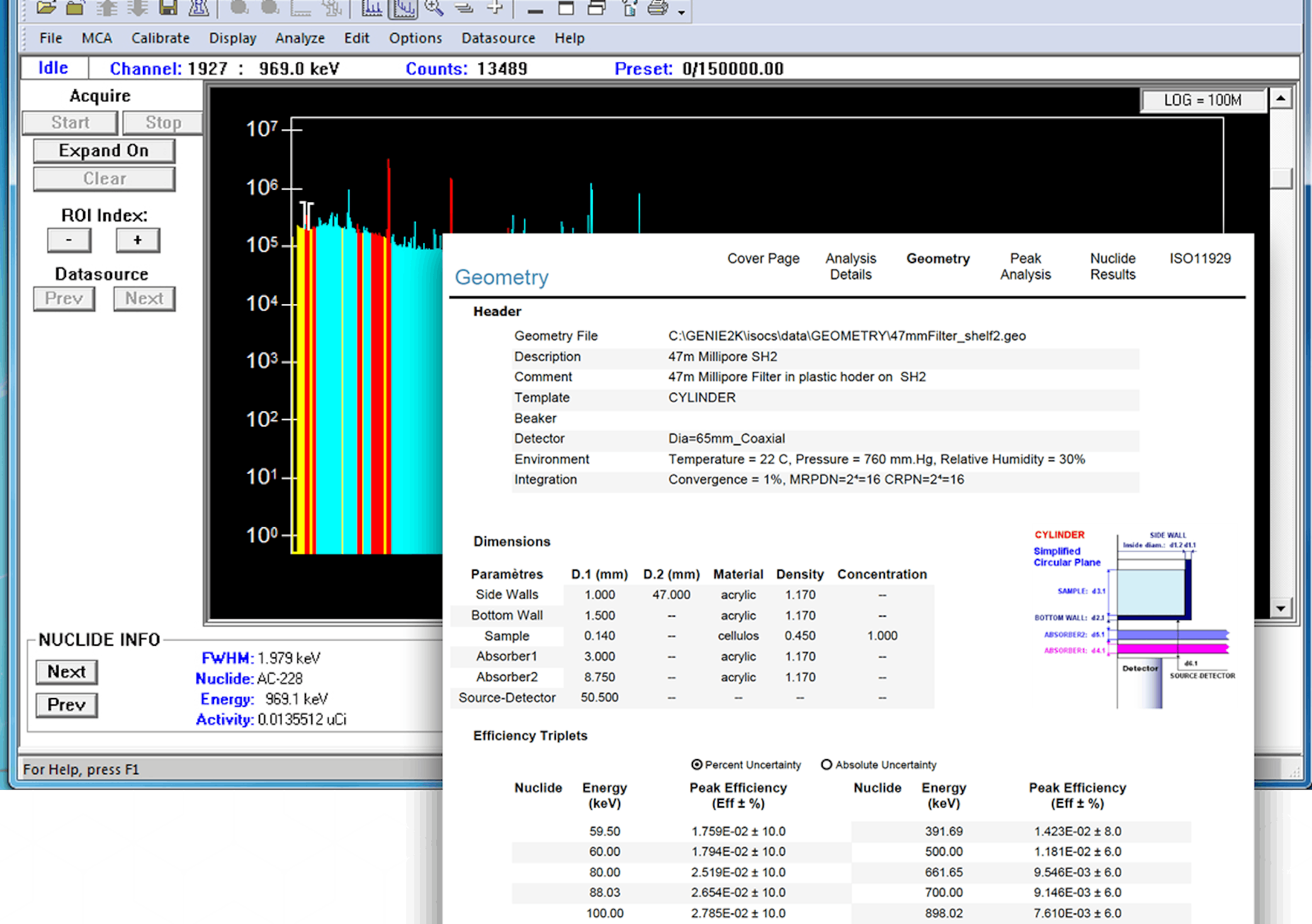
The Lynx is operated through CANBERRA's Genie 2000 and Apex spectroscopy software which provides the user with an extensive selection of application specific software options. The Lynx may also be operated via the Internet or a Local Area Network (LAN) without any spectroscopy software at all. Only a web browser is required for data acquisition display and control, system energy/shape calibration and operation of the digital oscilloscope from a Microsoft® Windows®, Mac OS® or Linux computer. The web browser capability can be used for controlling and checking count status from any computer on the Internet if permission is granted by the system administrator. However, more involved data analysis such as nuclide identification, activity calculation, etc., requires Genie 2000 or Apex software. An OS independent software development kit (SDK) with examples is available and can be used without Genie 2000. The SDK is similar to the comprehensive set of programming tools available with CANBERRA's OSPREY Digital Tube Base. It allows expert users to develop platform independent applications for instrument control and data acquisition.

Features
- Integrated rack mountable MCA based on Digital Signal Processing (DSP) technology
- Two groups of 32K channel conversion gain/spectral memory
- Operates in pulse height analysis (PHA), multichannel scaling (MCS), dual channel loss free counting (LFC), multispectral scaling (MSS) and time-stamped list modes
- Superior count rate and temperature stability
- Flexible range of processing time parameters for precise match to application requirements
- 10/100 Base-TX Ethernet, USB and RS-232 interfaces plus TCP/IP communications for fast, convenient industry- standard communications
- Full complement of control and signal input/output interfaces
- Three HVPS ranges to support detectors with low, medium or high bias requirements
- Advanced auto pole/zero US Patent #7725281, base line restoration and digital stabilization capability
- Adjustable digital signal delay for coincidence timing applications
- Multiple trace analog and digital oscilloscope to ensure easy setup and maintenance
- Full-featured support through Genie™ 2000/Apex® spectroscopy software
- Optional software development kit with examples
- Spectral display, acquisition control, energy calibration and instrument setup also available via built-in web server
OSPREY™: Universal Digital MCA Tube Base for Scintillation Spectrometry

Introducing Osprey™ – the ultimate solution for scintillation detector spectroscopy.
Description
Osprey™ from CANBERRA is much more than a tube base MCA for scintillation detectors. Besides the standard PHA mode of operation, it includes MCS, SCA, Multispectral Scaling, List, and Time-stamped List modes. With both Ethernet and USB 2.0 interfaces, Osprey is designed for remote or local operation. Plus, three user-configurable I/O ports provide maximum flexibility for data and control signaling.
An issue with scintillation detector spectroscopy is peak shifting due to changes in environmental temperature. Osprey, teamed with the CANBERRA NAIS-2x2 stabilized NaI(Tl) probe, solves the problem with patented* built-in LED stabilization technology.
*US Patents 7,005,646 B1 and 7,049,598 B1
Features
- All-in-one HVPS, preamplifier, and digital MCA
- Compatible with standard 14-pin scintillation detectors using 10-stage PMTs, including NaI(Tl) and LaBr3(Ce)
- Optional temperaturestabilized* NaI probe
- USB 2.0 connection for PC plug-and-play
- Ethernet 10/100T (PoE) connection for network applications
- PHA, MCS, SCA, MSS, List, and Time-stamped List modes
- Fully supported by Genie™ 2000 software and programming libraries
- Optional software development
kit with examples - Diagnostic web GUI
- Compatible with Model 727 shield
DSA-1000 Desktop Spectrum Analyzer
Description
The DSA-1000 is a full featured 16K channel integrated Multichannel Analyzer based on advanced digital signal processing techniques (DSP). When paired with the computer of choice, the DSA-1000 becomes a complete spectroscopy workstation, capable of highest quality acquisition and analysis. The instrument interfaces to all existing detector technologies like HPGe, NaI, Si(Li), CdTe or Cd(Zn)Te, PIPS® or X-PIPS.
The DSA-1000 offers cost effective, no-compromise DSP-quality spectroscopy in a very compact package. It is operated through CANBERRA's Genie 2000 spectroscopy software which provides the user with ultimate flexibility. A wide range of application specific software options are available under the Genie 2000 family.
The excellent performance of the DSA-1000 derives from the application of DSP technology. Earlier analog spectroscopy systems were prone to count rate and environmental instabilities that required continual adjustment of the signal processing subsystem - and often compromised analysis results. With the DSA-1000, these problems are dramatically reduced, without bulky packages or NIM bins.
The heart of the DSA-1000 is the Digital Signal Processor subsystem. Unlike conventional systems, which digitize the signals at the end of the signal processing chain, the DSA-1000 digitizes the preamplifier signals at the front of the signal processing chain. This approach minimizes the amount of analog circuitry resulting in increased stability, accuracy and reproducibility.

Features
- Integrated desktop MCA based on Digital Signal Processing (DSP)
- Excellent count rate and temperature stability
- Wide range of processing time parameters to allow precise match to detector characteristics and application requirements
- 16K Channel conversion gain/spectrum memory
- USB and RS-232 host interfaces allow simple connection to computer - no plug-in board or PC bus slot required
- Convenient small form-factor desktop package
- Full set of front panel indicators for HV, dead time and system status
- Performs pulse height analysis (PHA) or multichannel scaling (MCS)
- Digital oscilloscope to assist with setup
- Built-in power up diagnostics
- Supported by Genie™ 2000 spectroscopy software
InSpector 2000 DSP Portable Spectroscopy Workstation
Description
The InSpector™ 2000 is a high performance, portable spectroscopy workstation based on Digital Signal Processing (DSP) technol-ogy. Applications for the InSpector 2000 include all HPGe, NaI and Cd(Zn)Te detector applications common in environmental characterization; nuclear safeguards; decommissioning and decontamination; and in-facility monitoring. The instrument provides unsurpassed count rate and resolution performance coupled with environmental stability previously seen only in high-end laboratory systems. Package size and battery life set a new standard for field portability and convenience. The host Genie 2000 software environment provides the user with the ultimate flexibility in field operation. A wide range of application specific software options, designed specifically for field spectroscopy, is available under the Genie 2000 family.
The unprecedented performance of the InSpector 2000 derives from the application of DSP technology. Previously limited to laboratory applications due to the high power requirements of the internal components, DSP now gives the field spectroscopist the capability to perform high precision measurements in adverse environmental conditions with a portable instrument. Earlier analog spectroscopy systems were prone to count rate and environmental instabilities that required continual adjustment of the signal processing subsystem - and often compromised analysis results. With the InSpector 2000, these problems are dramatically reduced - while portability is significantly improved.
The heart of the InSpector 2000 is the Digital Signal Processor subsystem. Unlike conventional systems, which digitize the signals at the end of the signal processing chain, the InSpector 2000 digitizes the preamplifier sig-nals at the front end of the signal processing chain. This approach minimizes the amount of analog circuitry at the front end of the instrument, resulting in increased stability, accuracy and reproducibility.
The use of DSP technology also improves the overall signal acquisition performance. Signal filtering functions previously implemented in traditional analog electronics are limited. DSP allows filtering functions and pulse shapes that are not realizable using conventional analog processing techniques. The result is a more efficient trapezoidal filter function, which exhibits less processing time, less sensitivity to ballistic deficit, and superior resolution. With trapezoidal filtering, the pulses can be processed more rapidly and accurately, so the spectrum resolution is enhanced while throughput is increased.

Features
- Unsurpassed temperature stability for consistent, quality operation in adverse environmental conditions
- Accommodates a wide dynamic range of count rates, minimal loss of spectrum resolution
- Low system dead time to reduce count times and improve measurement accuracy
- Wide range of processing time settings to allow precise match to detector characteristics and application requirements
- Ultra small, ultra light weight package
- 10 hour HPGe battery life (12 hour NaI)
- Fast USB and highly optimized RS-232 host interfaces supported
- 16K Channel conversion gain/spectrum memory
- PHA and MCS modes supported
- Digital oscilloscope to assist with setup
- Built-in power up diagnostics